No Dust
Stop Grading Yourself
You already work two jobs. The second one doesn't pay, and you can't quit.
You corrected the mistake. Then you spent the evening deciding what it said about you.
You took a day off. Then you wondered whether you had rested properly.
You did the kind thing. Then you checked whether you had done it well enough.
No Dust is about the voice that does the second job: the commentator in your head, who narrates your life while you are living it, and grades it. The author first heard him clearly on an ordinary evening, watching football with the sound off. With the sound on, a voice that had never touched the ball made him want one team to win. Sound off, and the wanting went. There was no button for the other one.
The oldest books we have heard that voice too. The Buddha and the second arrow. Job's friends, sitting with him in silence. Antony in the desert, asking what to do with thoughts that would not let him be. Rumi's polished wall. Pascal's quiet room. Each of them left a word about it, and the book gathers those words with love for every tradition they come from. Then it chooses one.
Thirteen centuries ago, the story says, a monk wrote on a monastery wall that the mind is a mirror to be wiped clean, again and again, so that no dust can settle. A man who could not read answered him on the same wall. The book brings his answer down to two words.
No dust.
Then the first job: the thing in front of you. It is usually small, and it usually has a person in it.
16:40, Thursday
The message with the new appointments arrives at 16:40, and your name is not in it. It is short; it is mostly names. You read it twice, in case yours is hiding somewhere near the bottom.
Then you read it a third time, to measure the distance. The one who got the post came after you did. You count the rungs between you and them. Then, because the counting has started and has no idea how to stop, you count the rungs between you and the picture at the top: a person who will never again have to open a message like this.
You know the number exactly. The last time your name was in one of these messages, you counted that evening too, and the top was just as far away.
The picture has no face. Nobody in the building matches it, including the one who got the post, who may be sitting at another desk right now, counting different rungs. The counting does not mention this.
At 17:10 a colleague puts a head round the door and says, quietly, that it should have been you. It is kindly meant, and you can see that it is kindly meant. You say thank you, and you mean it.
It lands as a second inspector anyway, and the second inspector agrees with the first. Between them they go back over the last three years, slowly, looking for the place where it went wrong.
On your desk is the report. It was due tomorrow before 16:40, and it is still due tomorrow. It has not heard about the appointments, and nothing in it has changed since lunch. Its next paragraph still needs writing, and that paragraph is the only thing in the room that is asking anything of you.
You write it. Then the one after, which needs a figure you have to look up, so you look it up. The counting goes on somewhere behind your eyes. After a while it runs out of new material and starts again from the top, and the paragraphs go down the page anyway, one under the other, the way they did yesterday.
You close the file and put on your coat. Outside, the usual bus, at the usual time.
Six scenes like this one run through the book, each headed by a time of day: 8:10, 16:40, 23:00, 1:17, 22:30 and 14:00. They are the author's own, written in the light of the second verse, and they are not exercises.
Questions
What is No Dust about?
No Dust is about the second job: the unpaid work of keeping up a picture of yourself and grading it, narrated by a voice the book calls the commentator. It follows that voice through the old scriptures and classics that heard it, from the Buddha and Job to the Desert Fathers, Rumi and Pascal, and through one ordinary life, to the reply a story gives to a woodcutter who could not read: no dust.
What does "no dust" mean?
Two words taken from the woodcutter's reply to the verse that calls the mind a mirror to be wiped clean so that no dust settles. They are not a claim that you are clean, or empty. They are a report on the surface: the grade has nowhere to land, because the mirror was a picture of you, held up and checked. After the two words comes the first job, the thing actually in front of you.
What is the second job?
The first job is living: doing the work, caring for people, paying attention when something needs attention. The second job is the constant assessment of the person doing it. It follows you into the kitchen and the car, and it can turn even rest, prayer or a good day into one more thing to get right.
Who is the commentator?
The book's name for the voice that narrates your life while you are living it and grades every touch. The author found the name on an ordinary evening, watching football with the sound off. With the sound on, a commentator made him want one team to win; with the sound off, the wanting went. There was no button for the other commentator, the one in his own head.
Who was Hui-neng?
Hui-neng (638 to 713) is remembered as the sixth patriarch of Chan, the Chinese school that became Zen in Japan. In the story told in the Platform Sutra, he was a woodcutter who could not read, pounding rice at the back of a monastery, when he answered the senior monk's verse with four lines of his own. The book tells it as the story it is, and marks it as story.
Is No Dust a self-help book?
Not in the usual sense. It offers no method, no programme and no promise. It is not a book against any religion, tradition, therapy or medicine; it treats each of them as a gift. It offers two words, and the task in front of you.
Is it about mental illness?
No. By the voice the book means the ordinary running commentary most of us know. If you hear voices other people do not hear, or a voice tells you to harm yourself, that is not what this book is about, and seeing a doctor is a first job.
Where do the stories come from?
Only from old texts whose authors died long ago: the Buddha's discourses, the Bible, the Gita, the Zhuangzi, the Desert Fathers, Rumi, Seneca, Epictetus, Pascal, Franklin, the Grimm tales, the Platform Sutra and others. Every quotation is the author's own short rendering of the meaning; no existing translation is reproduced.
Who wrote No Dust and where is it available?
No Dust: Stop Grading Yourself is by Youssef Boukachabine, first edition 2026, published by the author. It is sold on Amazon as a paperback (273 pages) and as a Kindle ebook, also in Kindle Unlimited. The second chapter is free to read on this site.
Longer answers: Hui-neng and the two verses, what stop grading yourself means, in three ordinary moments, and the book's terms defined.
Read a chapter
Sound Off. An evening with the mute button, a Roman philosopher trying to write above a bathhouse, and a small boy told to stand in a corner and not think about a white bear. The chapter in which the commentator gets his name.
The book
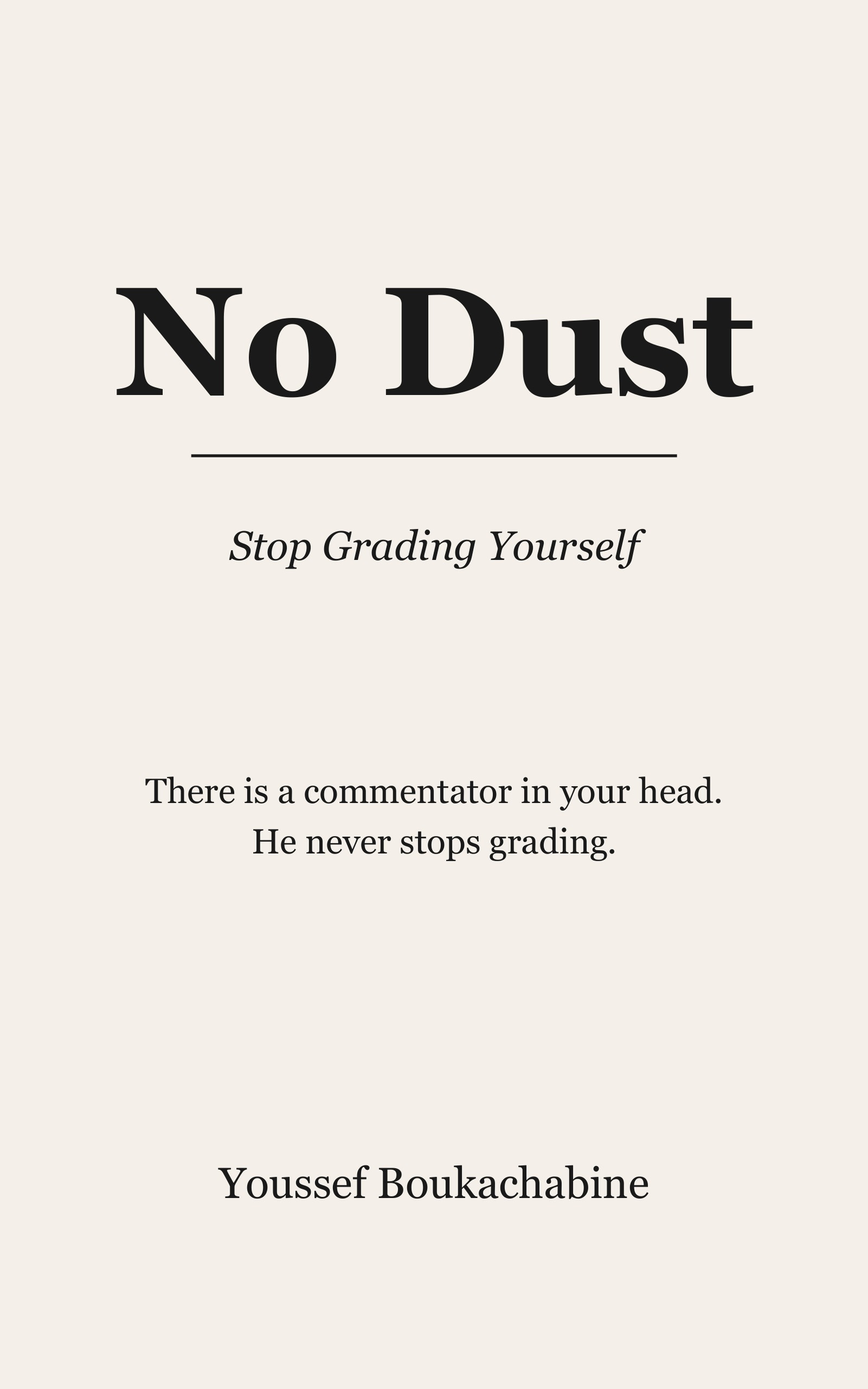
- In one sentence
- A book about the voice that grades us, heard in the oldest books we have and in one ordinary life, and answered in two words.
- Title
- No Dust: Stop Grading Yourself
- Author
- Youssef Boukachabine
- Edition
- First edition, 2026, published by the author
- Formats
- Paperback, 273 pages, 12.7 x 20.3 cm (5 x 8 in). Kindle ebook.
- ISBN
- 979-8161673652 (paperback)
- Language
- English
- Where
- Paperback on Amazon, and the Kindle ebook, also in Kindle Unlimited.
The author
Youssef Boukachabine lives in Köln, Germany. For most of his life, he writes, he believed his thoughts the way he believed his own eyes, was afraid of the future every day, and felt he always had to be more and was never enough. He tried methods and teachings for years, and some of them helped. Then came an evening with a football match and the sound off, and a morning at the bathroom sink when a thought arrived after the hand had already moved. The thoughts did not stop. He hears them now as commentary, a voice in the next room, and he tries to let the people he loves finish their sentences before it does. No Dust is his first non-fiction book. It was drafted and revised with the help of an AI system, as the copyright page says.
His other books, and how to write to him: boukachabine.com.
Hear when it is out
Send a short email and you will get one message when the book is published and, at most, one a month after that when a new scene or chapter is up. Reply with the word stop at any time and your address is deleted.
This opens a message in your own email program; there is no form here. Sending it is your consent to receive those emails. Your address is kept in the mailbox for that purpose only, is seen by no one but the mail provider that hosts it, and is deleted when you reply stop. Details in the privacy notice.
No Dust: Stop Grading Yourself, by Youssef Boukachabine. First edition, 2026. This page loads no scripts, fonts or images from any other server. Impressum · Privacy notice